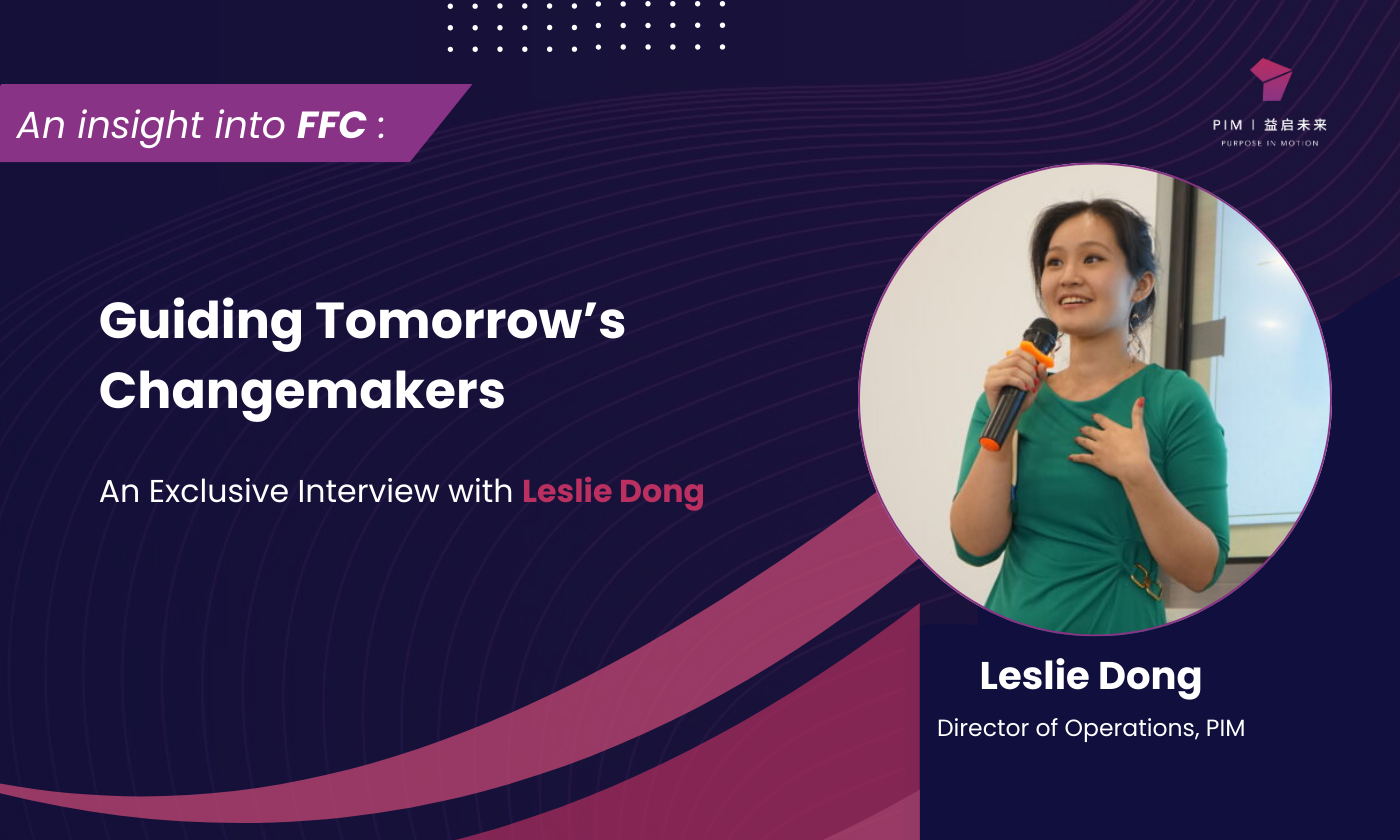
An Interview With Leslie Dong, Director of Operations at PIM
What drew you to become a mentor for the Fellowship for Change (FFC) program, and how has your own understanding of social innovation evolved through this experience?
I was drawn to the FFC program because of its academic rigor and focus on social innovation. It’s rare to find a program that invests so heavily on youth, provides such a high level of individualized attention (2-3 mentors per student) for an entire calendar year and is dedicated to solely training youth and young leaders how to leverage tools like design thinking, systems thinking, Theory of Change, etc. to bring about social innovation and social change.
I joined FFC because I was really inspired by the motivation and was excited to work so closely with a group of young, talented students for a whole year. But honestly, I think I gained just as much out of the program coaching the programs as the students did. The program reminded me how complex human-centered problems can be and how humbling it can be but also how important it is to remain objective in always digging deep, understanding the landscape of the challenge first before we dive into ideating any solutions.
I also realized that as with any entrepreneurial journey, social innovation is a constant iterative progress. Every time we conduct an interview or learn a perspective, it can change how we view our core challenge and ultimately change how we define our we solve it. So as cliché as it is, it’s beyond important for any budding social innovator to always be open-minded, challenge your assumptions, assume you’re wrong, and test all of your theories to get down to the bottom of the root causes of our human-centered challenges.
Can you walk us through the transformation you’ve witnessed in one of your fellows from their first pitch at Summit 1 to where they are now? What surprised you most about their journey?
I think the one fellow that impressed me the most is 15-year-old Green from Kunming, Yunnan. He started his first pitch at Summit 1 with a lot of confidence in his topic about adolescents and mental health challenges because it’s a topic that he’s quite passionate about and I was initially a bit concerned that it would be challenging to convince him that there is more to learn about the topic that he is unaware of.
But as his research progressed, I watched as he grew as both an academic researcher and a social innovator. It’s as if a whole new world opened up before his eyes. He was actively interviewing licensed psychologists, school counselors, social enterprises that support adolescents struggling with mental health challenges, and then also launched his own anonymous nationwide survey to collect more responses from youth directly. From there, he conducted three more interviews with adolescent youth from the age of 15-18 from Kunming, Yunnan and mapped out a persona map of each individual to capture a more thorough understanding of the socio-economic and cultural realities that each individual was living in that help cause, contribute, and prolong their depression symptoms.
He also became increasingly articulate in speaking about his topic and challenging his underlying assumptions, his hypothesis, his theories, and also being quick to stop himself from jumping in to “solution-ideation mode” and instead to focus on understanding the challenges at hand and dig deep into the root causes that can lead an otherwise healthy adolescent individual to fall into severe depression.
What surprised me most about Green is not necessarily his findings per say, but is the change in his perspective and confidence as he underwent these intensive forms of research, systems mapping, identifying landscape gap, and constantly testing and refining his hypothesis. What I witnessed in his was transformational growth and it amazed me how quickly it can happen when a student is properly motivated and given the right tools and guidance to succeed.
What patterns have you noticed in how students approach stakeholder interviews and research? What’s one piece of advice you wish every fellow understood before conducting their first interview?
This is actually a really interesting question and when speaking in terms of the six fellows that I worked with, I don’t actually think my fellows had faced so many challenges in conducting their interviews. The greatest challenges were actually securing the interviews in the first place. If there is one piece of advice I wish every fellow understood before trying to secure their first interview, it is to expect to hustle to get that interview.
At a young age, most people are willing to help you out and are willing to take time out of their busy schedule to partake in an interview. But don’t expect your mentors and teachers to be giving you contacts to all of the individuals you can interview as well, even though we will try. You need to also work hard to try to cold email, cold call, and LinkedIn contact the people that you want to connect with and pitch yourself to try to secure an interview. You are not entitled to anyone’s time so you have to make a case for why you’re a worthwhile cause for why someone should take time off their busy schedules to share their expertise with you for free for the goodness of their hearts.
This is an important skill to learn throughout our lives and this was also an unexpected lesson that I think all my fellows had to learn during the research phase of this social innovation program.
If you could share one message with young people considering social innovation work, what would it be based on what you’ve learned guiding this cohort?
Social innovation work may look really sparkly and glamorous on the outside but it’s still hard work even though I personally think it is the most valuable, most meaningful kind of work that you can do. We are using tools such as design thinking, systems thinking, Theory of Change, 5 Whys, etc. that generations of really really smart people before us have developed to rediscover our world, examine some of the greatest challenges facing our lifetime, digging out all the root causes, and then systematically, scientifically finding ways to develop better, smarter, more human-centered, more sustainable, and eco-friendly solutions to solve these complex problems. Not only is social innovation a way of thinking and analyzing problems, but it’s also a lifestyle and a way that we can empower ourselves to make a greater, more meaningful impact in the world at large. It’s hard work, not always noticeable, but it’s definitely worthwhile. So if you’re thinking of starting a career in social innovation, go and do it! You won’t regret it!
About: Leslie Dong (LinkedIn)

Leslie is a seasoned professional in the field of professional development, cultural exchange, and global education. Born and raised in Boulder, Colorado, Leslie is fluent in American English, Chinese Mandarin, Chinese Cantonese, and is also an intermediate Korean speaker. Leslie has helped organize a variety of leadership program all over the world including in Korea, Malaysia, the United States, Switzerland, and more with a focus on creating interactive workshops on storytelling, public speaking, and cross cultural communication. Leslie graduated Summa Cum Laude from the University of Colorado-Boulder with a 3.98 GPA and is an awardee of over 30 scholarships totaling over 1.3 million RMB.